
How EkGuru levels work — A1 to C2, and why C4 does not exist
Every course on EkGuru walks the same ladder: eleven rungs, from a child's first words to a lifetime of them. This page says exactly what each rung is, what it means you can do, how long it usually takes, and — because a level label is worthless if it is made up — which ones are the real international standard and which ones are our own half-steps.
The eleven rungs
The Common European Framework of Reference for Languages — the scale behind almost every exam in the world, from IELTS to Goethe to DELF — has six levels. It does not have an A3. It does not have a B3, a C3, a C4 or a C5. If a language school advertises "C5", that label does not exist in the framework, and no employer or university can check it.
So why does EkGuru have eleven rungs? Because learners kept asking for a smaller step than A1→A2, which can be six months of work. The honest way to do that — and the way established schools already do it — is the plus sign: A1+ means "A1 finished and A2 started". That gives six real levels and five honest half-steps: eleven rungs, no invented certificate. A learner who finishes A1+ can say they are at "A1 working towards A2", which is exactly what the label means.
| Level | What it is | What you can do at this level | Typical guided hours |
|---|---|---|---|
| A1 | First words | Greet someone, count to twenty, read a shop sign, say your name and where you are from. | 60–80 |
| A1+ | Getting around | Ask for things, give your phone number, name the days and the months, understand a simple direction. | 100–120 |
| A2 | Everyday sentences | Talk about your day, shop, order food, write a short message, understand slow clear speech. | 180–200 |
| A2+ | Holding a chat | Keep a conversation going for a few minutes, tell a short story about something that happened. | 250–280 |
| B1 | Independent | Explain a problem, write a real message, follow a podcast or a film with subtitles, handle a doctor or an office. | 350–400 |
| B1+ | Comfortable | Work in the language, argue a point politely, read a simple article without a dictionary. | 450–500 |
| B2 | Fluent enough | Read a newspaper, write a real letter, joke, follow a fast conversation between two native speakers. | 550–600 |
| B2+ | Professional | Run a meeting, read a contract, disagree well, switch register between office and street. | 650–700 |
| C1 | Nuance | Idiom, register, tone — and hear when something is slightly wrong. Write clearly on a complex subject. | 800–900 |
| C1+ | Almost native | Write for work, translate, teach a beginner, sit an entrance exam that assumes fluency. | 950–1,000 |
| C2 | Mastery | Poetry, law, humour — and the one mistake that still sounds foreign. Essentially everything a native speaker can do. | 1,100+ |
The hour counts are a planning number for a language that is not close to your own, counting guided study plus practice. They are the figures language schools use in their prospectuses, not a promise: how fast you move depends far more on how often you practise than on any method.
Why the picture changes age as the level goes up
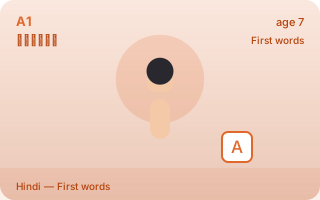
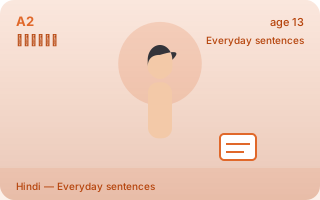
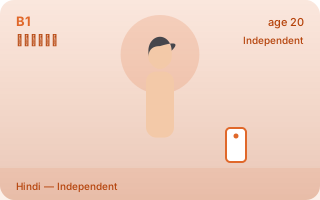
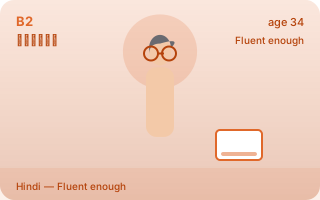
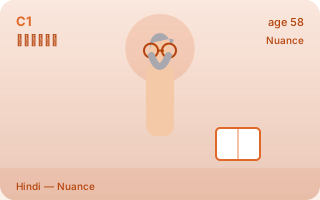
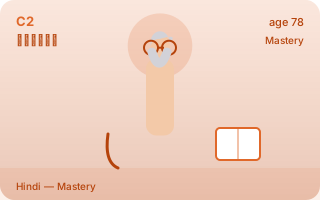
Every language hub on this site carries eleven figures, one per rung — and the figure is the level. A1 is a child learning first words. A2 is a teenager. B1 is a young adult, B2 an adult using the language at work, and by C1 and C2 the same person has grey hair, glasses and decades of it. It is one picture of one learner growing up with the language, so a glance at the strip tells you where a course sits.
It is a way of showing progress, not a claim about who may study: adults start at A1 every day, and a teenager can be at C1. The figures for Hindi and English, below, are the ladder a learner actually climbs.
How to use the levels on this site
- Find your language hub. Each one lists all eleven rungs, what you can do at each, and the figure that goes with it. All languages →
- Start where the description is true of you. If "talk about your day, shop, order food" is comfortable, start at B1 rather than replaying A1.
- Practise every rung, do not just read it. Reading a lesson is a third of the work; the quiz, the worksheet and the review deck are where a level actually sticks. Every language hub has lab, practice, quiz and review.
- Climb one rung at a time. The half-steps exist so that the next success is never months away.
- Take a tutor when you want one. Never required — see the tutors — and useful mainly from B1 upward, when the thing you need is somebody to correct you out loud.
See the ladder on a real course
A rung stops being abstract once it has a page. Every one of the 39 self-study courses here can be read level by level, without JavaScript and without an account: the lessons, the vocabulary with its romanisation, the grammar, the dialogues, the practice questions with the answers, the worksheet and the level test — one page per level, and one page that shows the whole ladder.
- Arabic: the six levels — and its first rung, Arabic A1
- Spanish B1 — a level where conversation starts, in the same shape as every other page here
- Japanese C2 — what the top of the ladder looks like
- Every language →
Each language's page for a level carries a picture of the learner at that rung, so the figures you see on the hub, on the level page and in this guide are the same learner growing up the ladder.
Questions people ask about the levels
Is there an A3 in CEFR?
No. CEFR has six levels: A1, A2, B1, B2, C1, C2. There is no A3, B3 or C3, and no C4 or C5 in the framework. Smaller steps are written with a plus: A1+, A2+, B1+, B2+, C1+ — which is what the eleven rungs on this site are. When an EkGuru course shows A3 or B3, that is an optional authored extension track, not a CEFR certificate, and unpublished extra levels are not indexed.
Do I have to start at A1?
No. Start where the description is honestly true of you. Guessing low costs you months of boredom; guessing high costs you confidence, so if you are between two rungs, take the lower one and finish it quickly.
Can I skip the half-steps?
Yes. They are there for people who want them, not a toll gate. A learner who goes A1 → A2 → B1 loses nothing.
Where can I be tested?
EkGuru's quizzes tell you how well you did on what this site teaches; they are not a certificate, and this site will not pretend otherwise. For a document an employer or a university accepts, sit an official exam — IELTS, Goethe, DELF, DELE, JLPT, HSK, TOPIK, and their Indian equivalents — and use this site to get to the level those exams ask for.
Ready to start? Hindi, 32 languages from Arabic to Vietnamese, or the course list.